
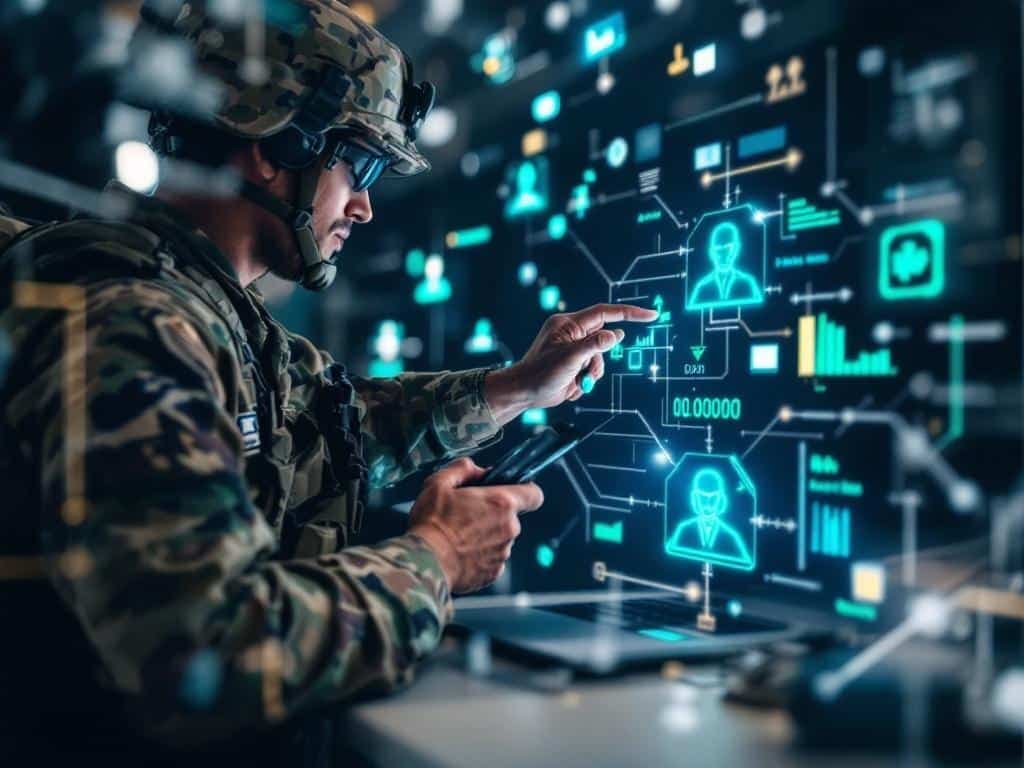
Rune Technologies, a young software company based in Arlington, Virginia, has just closed a $24 million Series A round for TyrOS, its predictive military logistics software. The round was led by Human Capital, with participation from Pax VC, Washington Harbour Partners, and existing investors: Andreessen Horowitz, Point72 Ventures, XYZ Venture Capital, and Forward Deployed VC. The US defense tech market attracted $3 billion in venture capital in 2024, according to PitchBook data, up 33% year over year.
A $24M Series A to move from POC to deployment
Rune Technologies was born at the intersection of two trends: the modernization of Department of Defense (DoD) logistics and the maturation of AI-powered predictive planning software. This Series A comes one year after a $12.8 million seed round led by Andreessen Horowitz, bringing total capital raised to more than $36M, as TechCrunch noted in its coverage of the deal.
The funding will be used to:
- double engineering and field deployment headcount
- scale TyrOS for operational US Army and US Marine Corps programs
- extend coverage to NATO allies identified as priorities by the DoD.
Team profile and investment thesis
Under the leadership of its CEO David Tuttle, a former US Army officer, Rune is assembling a team that blends special operations veterans with engineers from enterprise software. The investors' thesis - laid out by Human Capital in its press release - rests on the observation that military supply chains are still largely managed on spreadsheets and legacy systems, which renders them ineffective in a high-intensity conflict where communications are degraded.
TyrOS: AI-augmented military logistics
TyrOS is designed to turn manual, fragmented logistics processes into intelligent networks capable of anticipating needs, optimizing resources, and orchestrating distributed operations at machine speed. The platform combines several building blocks:
- Predictive consumption models (fuel, ammunition, spare parts) trained on operational histories;
- Multi-modal routing planner across air, sea, and land, factoring in platform availability and operational windows;
- Degraded mode that keeps operations running locally during network outages, with deferred synchronization once reconnected.
The bet on disconnected operations
TyrOS's key differentiator lies in its ability to keep operating even when supply lines are under attack or communications are down. Since the lessons learned from Ukraine, joint exercise leaders have identified logistics resilience as a critical priority. A 2024 analysis published by the Center for Strategic and International Studies (CSIS) estimates that up to 40% of operational losses in a major Indo-Pacific conflict scenario could be attributable to avoidable logistics disruptions.
Why defense tech is attracting venture capital again
The software defense tech segment is going through an active investment cycle. According to a study by CB Insights, the number of Series A and B rounds in this vertical nearly doubled between 2022 and 2025. Three structural factors explain this trend:
- The DoD's doctrinal shift, with the Replicator and CDAO (Chief Digital and Artificial Intelligence Office) programs, which open the door to contracts accessible to startups;
- The expansion of Other Transaction Authority (OTA), a contracting mechanism enabling faster procurement outside the FAR;
- Lessons learned in Ukraine, which accelerated awareness of the limitations of legacy tools in contested environments.
Anduril, Palantir, Shield AI: a mature ecosystem
Rune Technologies operates in an ecosystem where Anduril Industries (defense software), Palantir (data analytics) and Shield AI (aerial autonomy) serve as comparables. Anduril raised $1.5 billion in 2024 at a $14 billion valuation, as reported by Reuters. Palantir saw its US Army contract for Project Maven extended in 2025. This competitive landscape validates the market thesis and makes it easier for Rune to sell to DoD Program Managers.
The specific challenges of a defense software vendor
Selling software to a single customer whose buying cycle is measured in months, if not years, and whose requirements include complex certifications (FedRAMP High, IL5, IL6), calls for a specific kind of operational discipline. Rune Technologies will have to prove:
- the stability of TyrOS on operational programs (beyond Phase III SBIR);
- its ability to obtain Authority to Operate (ATO) at the required impact levels;
- interoperability with existing systems: Global Combat Support System-Army (GCSS-A), TC-AIMS II, Air Mobility Command tools.
The teams specializing in artificial intelligence know that deploying a predictive model in production is a distinct challenge from its laboratory performance; for defense tech, this is compounded by software supply chain security concerns.
Investors: who are Human Capital, Pax VC and Washington Harbour Partners?
The round is led by Human Capital, a San Francisco-based fund known for its early investments in Brex, Watershed and Multi. Pax VC is a fund specializing in technologies for regulated sectors. Washington Harbour Partners is a private investment vehicle known for its expertise in defense and intelligence markets. The retention of Andreessen Horowitz, Point72 and XYZ Venture Capital reflects the seed lead's conviction in the company's commercial trajectory.
Timeline and next steps
Rune's management has not shared a detailed timeline, but several milestones can be anticipated: the announcement of the first Phase III contracts, expansion into allied operations (Australia, United Kingdom, Poland), and the possible addition of complementary modules (predictive maintenance, crew management). The next funding round, likely a Series B, could come 18 to 24 months after this Series A if commercial traction is confirmed.
FAQ
How much did Rune Technologies raise in its Series A?
Rune Technologies raised $24 million in its Series A, bringing total capital raised to approximately $36 million when combined with the previous seed round.
Who are the lead investors in the round?
The round is led by Human Capital. Also participating are Pax VC and Washington Harbour Partners, along with existing investors Andreessen Horowitz, Point72 Ventures, XYZ Venture Capital, and Forward Deployed VC.
What does the TyrOS platform do?
TyrOS is predictive military logistics software. It combines consumption forecasting models (fuel, ammunition, spare parts), a multi-modal routing planner, and the ability to operate in disconnected mode when communications are degraded.
Which competitors does Rune Technologies face?
The defense tech logistics software segment includes players like Anduril (broader defense software), Palantir (data analytics), as well as legacy vendors (Lockheed Martin, Leidos, SAIC) that publish logistics modules for the DoD. Rune differentiates itself through its exclusive focus on predictive logistics and offline mode.
What will this Series A round fund?
Rune Technologies plans to double its engineering and deployment headcount, productionize TyrOS for operational US Army and US Marine Corps programs, and extend the solution to NATO allies identified as priorities by the DoD.