
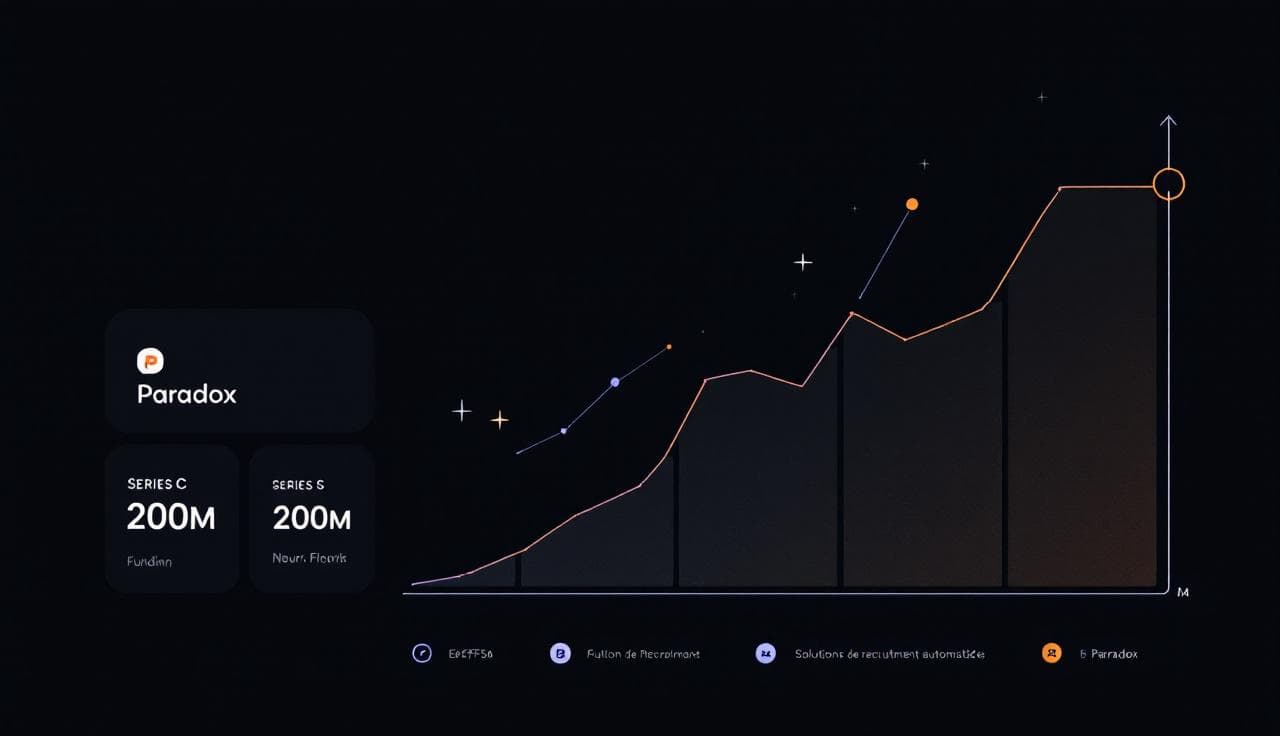
Paradox, the US company behind a conversational recruiting platform, raised $200 million in Series C funding in December 2021, reaching a valuation of $1.5 billion. The round was co-led by Stripes, Sapphire Ventures and Thoma Bravo, with participation from Workday Ventures, Indeed, Willoughby Capital, Twilio Ventures, Blue Cloud Ventures, Geodesic, Principia Growth, DLA Piper Venture Fund and existing investor Brighton Park Capital. Paul Melchiorre, operating partner at Stripes, joins the board.
Olivia, the AI assistant for hiring at scale
Paradox was founded in 2016 by Aaron Matos, an entrepreneur who previously launched Jobing.com. The company is based in Scottsdale, Arizona. Its value proposition comes down to one name: Olivia, an AI-powered conversational assistant that automates the repetitive tasks of high-volume recruiting. Olivia interacts with candidates via SMS, web chat or messaging, handles pre-qualification, suggests interview slots, schedules appointments and sends reminders.
The positioning targets the high-volume recruiting segment: retail, fast food, logistics, healthcare. These sectors process thousands of applications per month and suffer from an administrative bottleneck. According to data shared by Paradox at the time of the raise, its clients report a 50 to 80% reduction in time-to-hire and a significant improvement in candidate-to-interview conversion.
A blue-chip client base
Paradox counts companies like McDonald's, Unilever, CVS Health, General Motors, FedEx, and Lowe's among its clients. The McDonald's rollout, for example, enabled the fast-food chain to cut the time between application and hiring to under 24 hours in some US restaurants. This enterprise traction is a decisive argument for growth investors like Stripes and Thoma Bravo, who favor B2B SaaS with strong organic expansion within major accounts.
The HR tech market saw a marked acceleration during and after the pandemic. According to a Gartner study, HR software spending grew by roughly 12% per year between 2020 and 2023, driven by the digitalization of recruitment processes and the talent shortage in high-turnover sectors.
A top-tier growth investor syndicate
- Stripes: a growth fund based in New York with over $5 billion under management, notable investments in Ramp, On and Refinery29.
- Sapphire Ventures: a SAP spin-off fund specializing in enterprise SaaS, with over 11 billion in assets.
- Thoma Bravo: a tech private equity giant managing over $130 billion.
- Workday Ventures: the corporate venture fund of Workday, the leader in cloud HCM.
- Indeed: the number one job search engine and a natural commercial partner.
- Brighton Park Capital: a longtime investor that has strengthened its position.
The simultaneous presence of Workday Ventures and Indeed strategically validates Paradox's positioning in the HR tech ecosystem: Workday is the system of record for large enterprises, while Indeed is the primary acquisition channel for high-volume applications.
Competitors and benchmarks
In the conversational recruiting and AI automation segment, Paradox faces several direct competitors. Harver and Eightfold AI offer AI platforms focused on matching and assessment. Phenom People and Beamery are positioned in talent CRM. Recruiting chatbots such as Mya (acquired by StepStone) and Wade & Wendy have already been consolidated.
Paradox's competitive advantage rests on three factors: a product-market fit focus on high-volume recruiting (a segment often overlooked by competitors focused on white-collar hiring), native integration with the leading ATS platforms (Workday, SAP SuccessFactors, Oracle), and a candidate experience optimized for mobile (SMS remains the preferred channel for frontline roles).
How the $200M will be used
With this $200M round and a $1.5 billion valuation, Paradox has the means to significantly accelerate its growth. The company has announced three priorities: enriching the platform with new AI capabilities (notably asynchronous video assessment and semantic resume analysis), expanding internationally (Europe and Asia-Pacific), and acquiring complementary solutions.
Regarding international expansion, the European market presents a significant opportunity but also specific challenges: multilingualism, GDPR regulatory constraints, and a local competitive landscape more mature than in the United States. Maddyness observed in 2022-2023 an explosion in the number of French HR tech startups, with more than 600 players active in the segment.
A consolidating HR tech market
The HR tech sector is going through an accelerated consolidation phase. Acquisitions are multiplying: iCIMS acquired by Vista, Greenhouse acquired by TPG, Lever by Employ. Legacy ATS vendors (SmartRecruiters, Workable) are increasingly integrating AI capabilities to avoid being left behind. For Paradox, the challenge is to maintain its technological edge while expanding its features beyond pre-qualification, into assessment and onboarding.
The arrival of large language models (LLMs) since 2023 is also reshaping the landscape. Players like HireVue and Beamery quickly integrated GPT-like capabilities into their platforms. Paradox must therefore both capitalize on its lead and reinvent itself in the face of competitors who no longer need complex proprietary models.
Takeaways for the French ecosystem
For the French HR tech ecosystem, Paradox's rise is instructive on several fronts. First, it shows that a strong sector focus (high-volume recruiting) can lead to unicorn valuations, whereas a horizontal approach often results in more modest trajectories. Second, the $200M round illustrates the capitalization gap between the US and European ecosystems: no French HR tech company currently reaches these funding levels.
For growth operators in B2B SaaS, the Paradox model offers concrete lessons on enterprise conversion and expansion through ATS integration APIs. Our AI expertise and our growth marketing expertise cover these high-impact integration and automation architectures.
FAQ
How much did Paradox raise in its Series C?
Paradox raised $200 million in Series C funding in December 2021, reaching a $1.5 billion valuation.
What does Paradox do?
Paradox develops Olivia, an AI conversational assistant that automates repetitive tasks in high-volume recruiting: pre-qualification, interview scheduling, reminders, and candidate follow-up.
Who are Paradox's main clients?
Paradox claims clients such as McDonald's, Unilever, CVS Health, General Motors, FedEx and Lowe's, mainly for high-volume recruiting use cases.
Who leads Paradox?
Paradox was founded in 2016 by Aaron Matos, who serves as CEO. The company is based in Scottsdale, Arizona.
Who are Paradox's competitors?
Paradox competes with platforms such as Harver, Eightfold AI, Phenom People and Beamery in the AI HR tech segment. It stands out through its focus on high-volume recruiting.