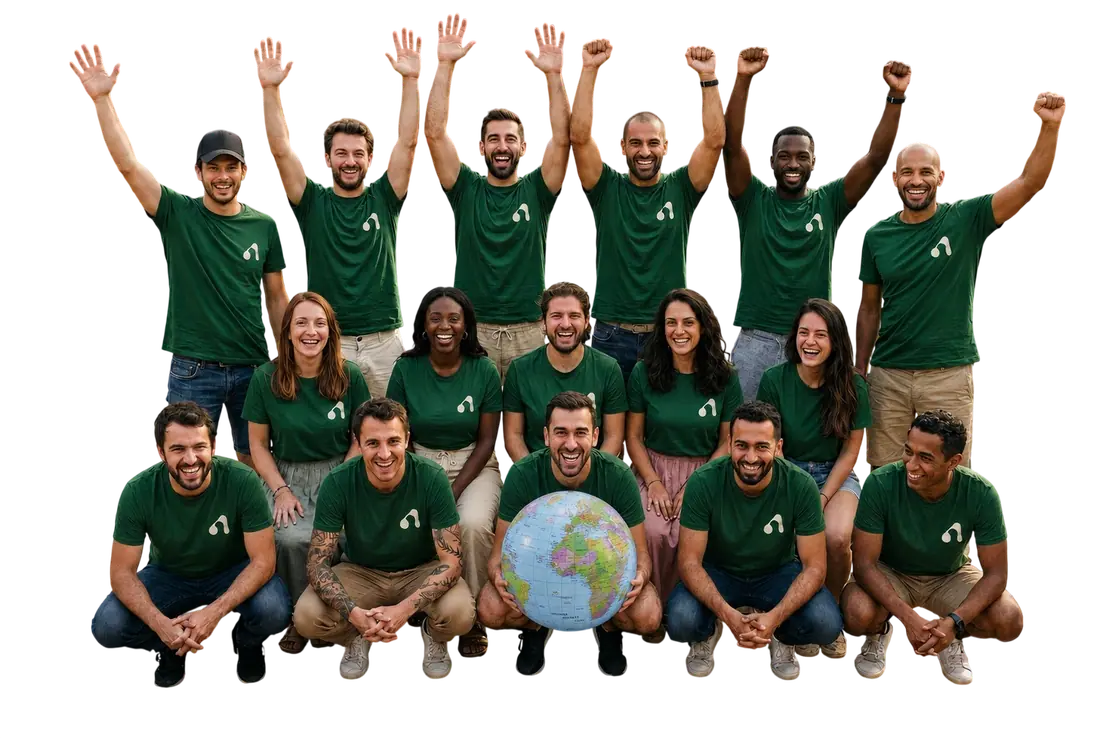
An equity management platform born in the UAE and looking to Europe, founders with backgrounds in audit, investing and entrepreneurship, a model that sells advisory alongside the software, and a pre-seed announced almost a year after it closed, to open the seed. A look back at a fintech funding round, and at a go-to-market built around the moments when a company has to manage its equity.
On October 20, CapQuest announced a $1 million pre-seed round led by Oraseya Capital and AMKM Family Office. Founded in 2023, the startup builds an equity management platform: cap table, employee stock option plans, convertible instruments and investor relations. It is headquartered in Dubai and has customers in eleven countries. The funds will go to product, automation and commercial expansion. The round had in fact closed at the end of 2025, with the last investors coming in in January: CapQuest is announcing it now to support the opening of its $2 million seed round.
At Uclic, we like to go beyond the press release. I spoke over video with two members of the founding team: Antoine Bruna, co-founder and CEO, who splits his time between Paris and Dubai, and Remy Bezou, CRO. The conversation was in French, even though Remy Bezou hasn't lived in France for twenty-five years. That day, CapQuest's data room was going into production, and Antoine Bruna had just come out of a testing session with the team. They told me how the project started, about a model that combines software and advisory, how they raise, and about a go-to-market timed to their future customers' funding rounds.
A problem seen from both sides of the table
Antoine Bruna started his career at Mazars, now Forvis Mazars, in audit and transaction services. There he worked with funds buying companies, and saw up close how a cap table evolves from one deal to the next. After moving to Dubai in 2014, he managed clients' private investments, directly in startups or through funds. He then became co-founder of one of the companies his clients had invested in: Repeat, an app for restaurants.
At Repeat, the team raised $12.5 million from 47 investors: business angels, family offices and venture capital funds. Sixty-three employees were part of a stock option plan. In 2022, after Repeat expanded into the United States, Antoine Bruna, his partner Marco Banfi and half of the shareholders sold part of their shares to an American acquirer.
“I handled the fundraising, investor relations, every equity movement. Coming from advisory, it was important to me to put real governance in place. And we were managing all of it in Excel.”
He looked at Carta, the leading American player in the space, without being convinced. “It was too US-centric. We had a holding company in ADGM, in Abu Dhabi, which is pretty much the standard in the Middle East.”
The third co-founder, Anvita Varshney, brings the investor's perspective. She has worked at Google, Rocket Internet (Lazada) and Prosus (OLX), co-founded the Dubai Angel Investors network, and runs her own investment vehicle, AV Capital Partners, with around twenty portfolio companies. The team therefore knows the subject both as founders and as investors.
Math, not legal work
The platform covers the cap table, share classes, employee stock option plans and their vesting, SAFEs and other convertible instruments, dilution modeling ahead of a round, and portals for employees and investors. On top of that come an investor reporting module, built with venture capital funds from a quarterly template, and the data room launched on the day we spoke. The company fills in an Excel file, uploads it, and its investors receive an online report they can view from their own portal.
For Antoine Bruna, many players in the market were built as legaltech companies, often founded by lawyers. In his view, that choice is ageing badly.
“Today, with AI, everything legal and compliance-related is losing its value: it's a depreciating asset. We focused on financial engineering. Whether you convert a SAFE or a BSA AIR [the French equivalent of a SAFE], the math is the same.”
That is what lets CapQuest serve several countries with a single platform, by automating the corporate finance calculations behind equity movements. What comes next follows the same logic: in the first quarter of 2027, CapQuest is due to open up to investment funds, with portfolio management, LP reporting and valuation updates. Many funds still work in Excel, with highly manual processes.
“When people ask me what CapQuest's focus is, it's data. For funds and companies alike, it's about providing a level of benchmarking and understanding of fundraising and capital allocation that doesn't exist on the market today.”
Software sold with advisory
The second structural choice is about service. For the founders, even a technically very mature product is no longer enough to stand out. So alongside the platform, CapQuest has built a team that advises client companies. According to Remy Bezou, this is often what wins over customers coming from competitors.
“For many customers who moved from Carta to CapQuest, the service was a huge change. They can get on a call with me, with Antoine, with Marco or with the team, to ask questions about a term sheet they've received or a stock option plan they want to launch. We help them understand the impact it will have on their cap table.”
This advice draws on the founders' experience, but also on the hundreds of cap tables and situations the team has seen, including at companies that did not become customers.
“Lots of founders come and ask us what others are doing. Which structure they chose, what's working right now in stock option plans to attract people or to keep them.”
Antoine Bruna sees this as a response to how software is changing: a technology company now has to integrate vertically with services, or bet on data. AI agents make this model sustainable with a small team.
“Ten years ago, I wouldn't have had this view of how you build a company. Today, we manage to be efficient on advisory, benchmarking and data thanks to agents. SaaS and consulting are two industries that are set to change enormously. Combining them, with the right data points, means building a business that holds up for the next ten years.”
He sums up the result in one line: “a slightly weird hybrid business, but one that speaks to investors”.
A pre-seed closed a year ago, announced to launch the seed
The million dollars announced in October was raised in about eight months, from a dozen investors. The only venture capital fund in the round is Oraseya Capital, chosen for its ties to the Dubai authorities.
“Oraseya Capital is the venture capital arm of the Dubai government. In terms of partnership and economic zone, it made sense to have the regulator itself invest in the company.”
The other investors are experienced business angels, co-founders of angel networks and fund managers, including the manager of a new Saudi fund dedicated to AI.
“We must have spoken to 25 people, and we have 12 investors in the pre-seed. It's always easier when you're a repeat founder. Investors know the problem, we don't need to explain it to them. What they mostly want to know about is the competition and the go-to-market.”
The late announcement is deliberate. It generates inbound interest from investors just as CapQuest opens its $2 million seed round, launched two weeks before our conversation. “So far, we haven't had a single no. Everyone is in due diligence.”
For Antoine Bruna, a round is prepared well before you need the money. He met Oraseya Capital's fund manager in 2024, for a round that closed at the end of 2025. Every quarter, CapQuest sends a newsletter with its figures and analysis, to its shareholders as well as to investors who are not yet on the cap table.
“It's not a pitch deck or a polished data room that will convince investors. They want to know who they're investing in, especially early on. If they know you, your chances are much higher.”
He also has a firm view on impostor syndrome, which founders often bring up.
“I think impostor syndrome is when you know you haven't done enough work on your subject beforehand.”
His data room represents three months of work: a full market analysis, a growth plan, financial projections. He writes his documents himself. “You can't just ask AI to do your financial projections and then never open the Excel file.” The bar is even higher for CapQuest: the funds it is approaching will also be its customers, and the team has to know their business as well as they do.
Prospecting when the company raises
This is the part we at Uclic find most interesting. CapQuest first sold in its own region. For Remy Bezou, the company was created “in the UAE, by the region, for the region”, facing American players who arrived in the Middle East without adapting their product. Customers then came from elsewhere, organically at first: the United States, Latin America, Europe, Asia.
The method rests on two things, Antoine Bruna explains: credibility, and the trigger. CapQuest has mapped out the moments when a company needs it, “from the first SAFE to the exit”: understanding the effect of converting its first SAFEs or BSA AIRs, issuing its first employee stock option plan, bringing in Series A investors, managing share classes with liquidation preferences. The team is happy to welcome seed-stage startups, notably through partnerships with accelerators around the world, but focuses its efforts on Series A companies and beyond: more revenue, less churn, and institutional investors on the cap table who discover the platform.
Having joined about a year ago, Remy Bezou started with volume.
“The first phase was trying a bit of everything and seeing what bites.”
CapQuest tested several approaches, including high-volume automated outbound. The team came away with a conviction: for a product like theirs, every outreach has to be personalized and carried by someone who knows the subject.
“I'm convinced that the SDR approach, truly personalized selling, works better for certain products. CapQuest is one of them.”
Prospecting is built on funding announcements worldwide: subscriptions to Crunchbase and other databases, and partnerships with figures in the Middle East startup ecosystem who hear very early about rounds in preparation. CapQuest is also funding its SDR's master's degree in finance, so that she can talk equity on an equal footing with the people she speaks to.
“A founder gets 30, 40, 50 emails a day. They only reply to people who are different, and who understand their business and the product they're selling.”
AI has its full place in this setup: it prepares the sales team's work, ahead of the conversation.
“The AI we like is the kind that gives SDRs the right tools to do their job faster and better, and to find their customers' data and history as quickly as possible.”
Country-by-country teams, with Europe in sight
What comes next is already planned. Remy Bezou built an internal tool, the Sales Hub: a world map that brings together funding data (who is raising, when and where) and ranks companies into categories from A to E. The next countries are chosen based on this data.
“With Antoine, Marco and Anvita, we agree on the next five countries. And in each one, I hire SDRs who speak the language, who understand the ecosystem, the market, the funds that invest there.”
The analysis of the next markets puts Europe first, with France and Germany: according to Remy Bezou, companies there are not very satisfied with the tools they use. Antoine Bruna is already very present there. He spends half his time in Paris, teaches at Station F as part of the Fighters program, and works with accelerators such as Antler and Diversidays, as well as Moonshot and Reach in the United States.
Both are keen to correct a perception: in Europe, a company based in Dubai often attracts suspicion.
For Antoine Bruna, building a company in the Gulf actually takes a lot of effort. Venture capital funds allocate less capital there than in France, there is no public support comparable to Bpifrance, France's public investment bank, and the small size of the market forces companies to expand internationally very early.
“When we went to the United States with Repeat, I realized how easy it was to raise money and expand your market, compared with everything we'd had to do in the UAE to establish ourselves.”
Excel, the first competitor
CapQuest's main competitor isn't always another software vendor. Remy Bezou says so plainly.
“My favorite customers are companies that still use Excel.”
The team recently met a unicorn that was still managing its equity in Excel. For its large customers, CapQuest handles the entire setup from the documents they send over, which makes switching tools painless.
Inbound, the 2027 project
Until now, CapQuest has grown almost entirely through outbound. For the past two months, the team has been building its inbound acquisition, with Google Ads and SEO, and plans to work on social media and content in the first quarter of 2027. For Remy Bezou, the goal is clear.
“I always say that if we can make money while we sleep, that's what's great. You get up in the morning, open your computer, and the Americans sent requests the afternoon before.”
Antoine Bruna distinguishes two uses of inbound. The first serves credibility: being visible on Google, in AI answers and on social media confirms, after a demo or a first email, that the company is serious. The second generates pipeline, especially among first-time founders who don't yet know this kind of tool. He warns against investing in inbound without knowing what you expect from it.
Key takeaways
Three lessons from this conversation that go beyond fintech.
First: a technically mature product is no longer enough to stand out. CapQuest's founders saw this, and built advisory and data around their platform. Their customers come for the tool, but also to be able to call the team before signing a term sheet, and to find out what other companies are doing. AI agents make this advisory sustainable with a small team.
Second: AI is most useful when it equips salespeople. At CapQuest, it gathers each prospect's data and history, so that the person reaching out already knows the subject. With founders receiving dozens of emails a day, personalization is what makes them want to reply.
Third: timing matters as much as the message. CapQuest prospects based on specific events in a company's life, from the first SAFE to the Series A. It applied the same logic to its own round, announcing its pre-seed as it opened its seed.
We'll be following CapQuest's seed round and its expansion into Europe closely.
CapQuest at a glance
- Headquarters: Dubai. CEO Antoine Bruna splits his time between Paris and Dubai.
- Founded in 2023 by Antoine Bruna (CEO), Marco Banfi and Anvita Varshney. Remy Bezou, CRO, is part of the founding team.
- Product: equity management platform (cap table, share classes, employee stock option plans and vesting, SAFEs, BSA AIRs and other convertible instruments, dilution modeling, employee and investor portals, investor reporting, data room).
- Roadmap: modules for investment funds (portfolio management, LP reporting, valuations) in Q1 2027.
- Business model: subscription based on the number of stakeholders managed (shareholders, employees, investors), with support from the team, and setup handled by CapQuest for large customers.
- Customers: companies in eleven countries, including Holo, erad, Avenia and Teylor.
- Latest round: $1 million pre-seed led by Oraseya Capital and AMKM Family Office, with around a dozen investors. Closed at the end of 2025 (last investors joined in January 2026), announced in October 2026.
- Ongoing: $2 million seed round, opened in late October 2026.
- Website: capquest.io
Article published by Uclic, a growth marketing and AI agency. Interview conducted by Alexis Christine-Amara on November 12, 2026.