
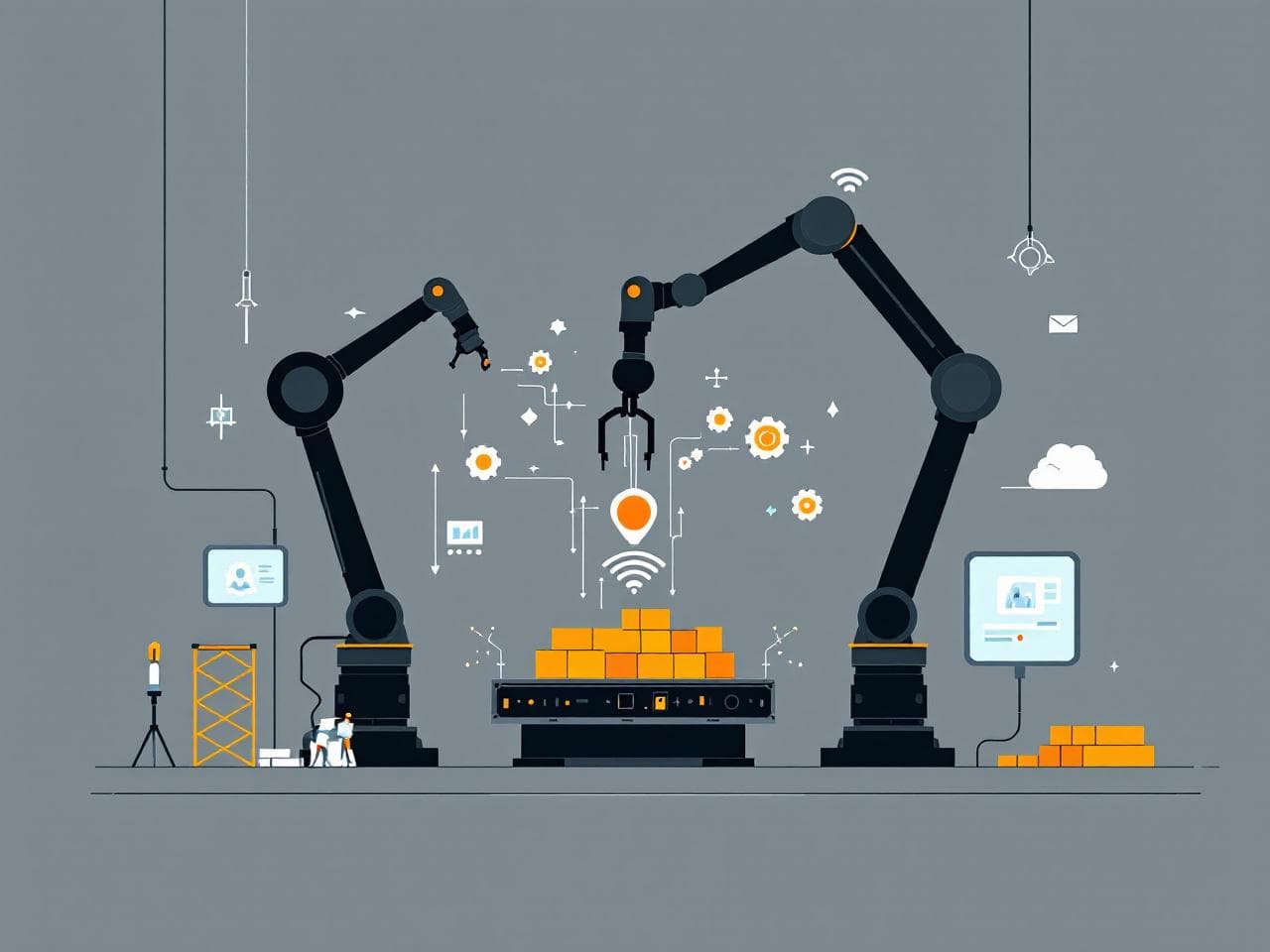
Notom, an Île-de-France deeptech company specializing in industrial automation, announced on 21 January 2026 a €2 million seed round led by SistaFund with Kima Ventures, Olympe Capital and several business angels from the industrial sector, including Aude Guo, CEO of Innovafeed. The round will fund a no-code platform that connects existing machines to modern digital tools, bringing AI into factories without replacing existing equipment.
A deal signed by former Innovafeed employees
According to Maddyness, Notom was founded in 2025 in Saint-Ouen-sur-Seine by Paola Fedou (CEO) and Jean-Philippe Gross, two engineers who worked on the automation of large-scale industrial sites at Innovafeed, the French scale-up producing insect-based proteins for animal feed, as documented by L'Usine Nouvelle.
Six months after its founding, the company employs around ten technical staff and counts several pilot customers in the agri-food sector, a vertical naturally close to the founders' background. SistaFund is leading the round; Kima Ventures (Xavier Niel's historic fund, active in tech seed investments) and Olympe Capital (impact tech) are joining as co-investors.
The product: three modules to democratize Industry 4.0
The Notom platform is built around three modules:
- Connect: an interoperability layer for programmable logic controllers (PLCs) and industrial systems (OPC UA, Modbus, MQTT, proprietary SCADA protocols), with mTLS encryption to secure OT communications.
- Interact: a user interface that lets operators and line managers operate the machine fleet without development expertise, with native configuration versioning.
- Integrate: an AI layer for anomaly detection, energy optimization, and predictive maintenance on the collected data.
The key differentiator is a deployment claimed to be twice as fast as traditional OT (Operational Technology) solutions, with a no-code approach rather than a conventional IT project lasting 6 to 18 months. Early pilot deployments show productivity up 30%, fault detection accelerated tenfold, and energy optimization that is agnostic to plant type.
Why aim for modernization rather than replacement
Europe's industrial installed base is largely fully depreciated. A significant share of the programmable controllers installed in plants are more than 15 years old and run on proprietary architectures (Siemens S7, Schneider M340, Rockwell ControlLogix). Replacing this equipment typically costs several million euros per site and requires several weeks of production downtime. Modernizing through a software layer, with no hardware changes, is far less risky and can be financed as opex.
The stakes are all the higher as competitive pressure is pushing European manufacturers to catch up on digitalization, as regularly highlighted by the annual barometer published by L'Usine Digitale. According to industry analyses, Industry 4.0 adoption in Europe remains below 30%, compared with nearly 50% in the United States and over 60% in some regions of Asia.
The IIoT and OT platform market
The IIoT (Industrial Internet of Things) and OT/IT bridge platform segment is one of the most competitive in industrial SaaS. In the enterprise segment, the established players are PTC ThingWorx, Siemens MindSphere (rebranded Insights Hub), GE Digital Predix and Microsoft Azure IoT. In the mid-market and SMB segments, challengers like Tulip Interfaces (US, valued at over one billion dollars), Litmus, Highbyte and Germany's Cybus are pushing a more modern, flexible approach.
Notom's French angle (no-code, AI-ready, focused on food and beverage SMEs and mid-caps as a first step) is similar to Tulip Interfaces', but with native generative AI integration from the seed stage, whereas Tulip added these capabilities to a product core historically built around operator workflows.
Execution challenges for Notom
- OT sales cycle: penetrating an industrial site typically takes 6 to 12 months from first contact to signature, with sign-off from production, quality, IT security and procurement. An industrial PoC ties up teams for several months.
- AI layer maturity: predictive maintenance and anomaly detection are recurring promises, but models often struggle to outperform benchmarks derived from legacy business rules. Field validation is critical.
- Competition from hardware players: PLC manufacturers (Siemens, Schneider, Rockwell) are progressively adding native software layers to their equipment, which could reduce the relevance of third-party platforms.
The opportunity for French Industrial Tech
The deal is part of a wave of funding rounds in French industrial tech: Toucan Toco (industrial BI), Outsight (industrial lidar), Augury (acquired by Augury US but with French DNA). Notom's bet is to combine two recent theses: no-code (democratizing technical tools) and agentic AI (automating operational decisions), applied to a historically conservative sector.
For industrial technical leadership teams and the growth ecosystems that support them, these new platforms offer fast, high-ROI optimization opportunities. Applied artificial intelligence and growth marketing agencies can help bring these solutions to market at scale across industrial SME and mid-cap segments.
FAQ
How much has Notom raised, and when?
On January 21, 2026, Notom announced a €2 million seed round led by SistaFund, with participation from Kima Ventures, Olympe Capital and several business angels from the industrial sector.
Who are the founders of Notom?
Notom was founded in 2025 in Saint-Ouen-sur-Seine by Paola Fedou (CEO) and Jean-Philippe Gross, both former engineers at Innovafeed. They previously worked on automation projects for large-scale industrial sites in France and internationally.
How does the Notom platform work?
The platform is built around three modules: Connect (OT/IT interoperability with mTLS), Interact (no-code control for operators with native versioning) and Integrate (AI for anomaly detection, energy optimization and predictive maintenance).
What results does Notom claim from its pilots?
According to Maddyness, the first pilot deployments show a 30% productivity increase, fault detection ten times faster, and energy optimization that works regardless of factory type. The company is already working with several clients in the food industry.
Who are Notom's direct competitors?
In the modern IIoT/OT platform segment, direct competitors include Tulip Interfaces (US), Litmus, Highbyte, and Germany's Cybus. The established players (PTC ThingWorx, Siemens Insights Hub, GE Digital Predix, Microsoft Azure IoT) remain dominant in the enterprise space, but with longer implementation cycles and a significantly higher total cost of ownership in the first years of deployment.