



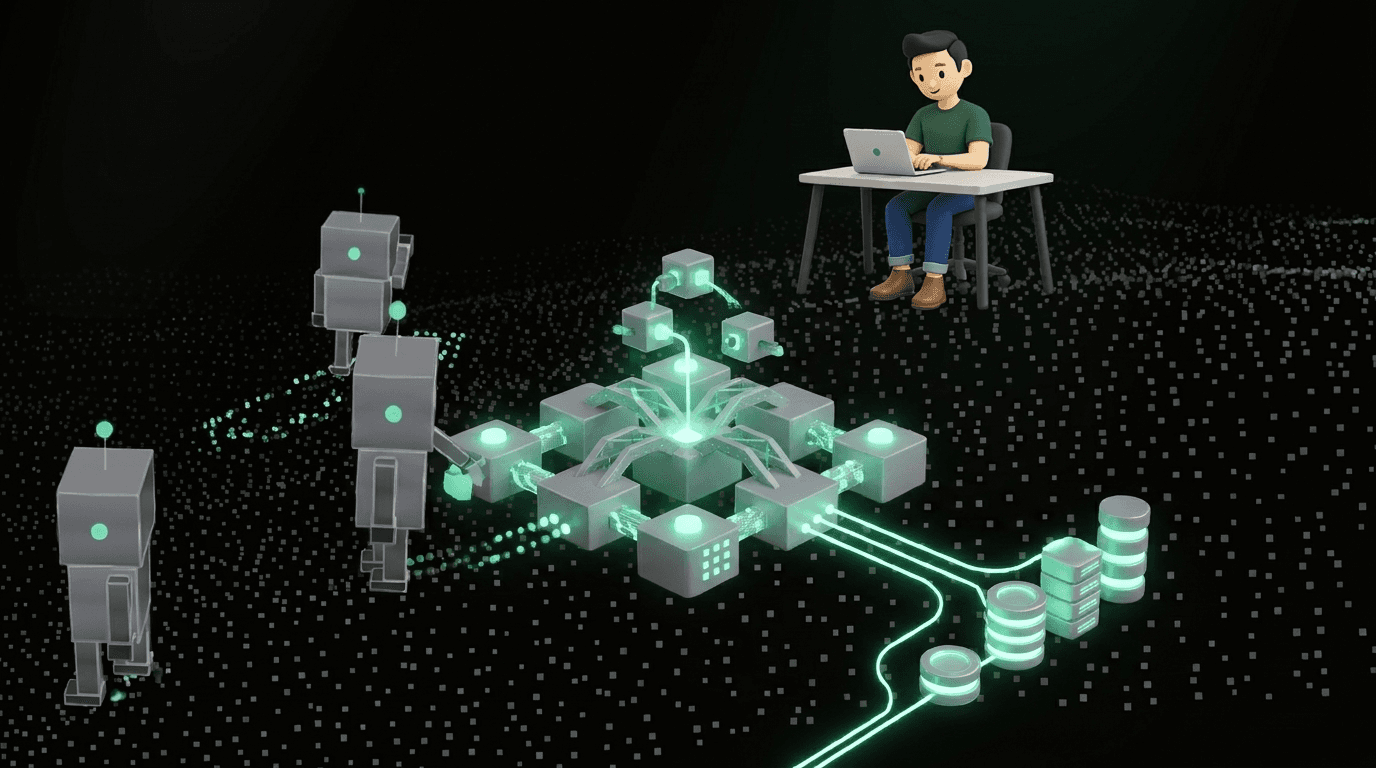
Intelligent machines are multiplying, but they rarely speak the same language. A look at a strategic investment that opens Japan to RSYNQ, and at a deliberately narrow go-to-market.
RSYNQ has received a $2 million strategic investment from Kanaden Corporation, announced on October 19, 2026. The Torrance, California startup builds SIP (Semantic Intent Protocol), an orchestration layer that coordinates robots, sensors and machines from different vendors. The money will advance the platform and open the Japanese market, one of the world's leading markets for robotics and industrial automation.
In an official statement and an accompanying executive Q&A, RSYNQ covers three topics: how the Kanaden partnership shapes its entry into Japan, why SIP replaces no existing machine, and how the company plans to measure progress without chasing visibility.
RSYNQ at a glance
- Company: RSYNQ Corporation
- Headquarters: Torrance, California, USA
- Leadership: Alex Mecl, co-founder and CEO
- Business: Physical AI infrastructure, an orchestration layer between AI applications and physical machines
- Product: SIP (Semantic Intent Protocol), hardware-agnostic middleware that turns intent into coordinated actions across multi-vendor equipment
- Round: $2M strategic investment, announced October 19, 2026
- Investor: Kanaden Corporation (Japan)
- Target market: Japan, with joint business activities starting in Q4 2026
- Tagline: "Orchestrating Intelligent Motion. From Intent to Choreography."
The problem: intelligent machines that don't talk to each other
A modern factory or warehouse runs robots, controllers, sensors and equipment from different brands, each with its own protocols and proprietary integrations. Adding a machine often means writing one more integration. That fragmentation is what RSYNQ wants to fix.
"We believe the future of Physical AI will depend not only on more capable individual machines, but also on the ability of intelligent systems to work together across complex environments," the company writes. Its message fits in one sentence: "RSYNQ enables intelligent machines to work together, regardless of manufacturer or platform."
SIP: a layer above the machines, not instead of them
SIP is positioned as a hardware-agnostic orchestration and choreography layer. It tracks device state, dependencies and execution, and verifies that intended outcomes are achieved. Leadership is clear about what the platform does not do: "Rather than replacing existing robots, controllers, industrial protocols, or safety systems, SIP is designed to help connect intelligent applications with heterogeneous physical systems."
Device-level and safety-critical controls stay in place. SIP works above them, through a common semantic framework that reduces integration complexity. For an industrial buyer, the pitch is concrete: deploy and expand automation without being limited by isolated systems or proprietary integrations. Further technical details, the company says, will be shared selectively as the product and customer programs progress.
Go-to-market: entering Japan through Kanaden
The split of roles is clear. Kanaden brings its market presence, industry relationships and distribution capabilities; RSYNQ owns the platform, technical innovation and customer support. "Our initial focus will be on targeted customer engagements, proof-of-concept projects, and scalable commercial opportunities," leadership explains.
The first conversations will be with organizations already facing practical challenges in coordinating multiple intelligent systems. These engagements should validate customer needs, demonstrate SIP's capabilities and inform future commercial deployments. Customer names, commercial terms and deployment details remain confidential.
For outbound, RSYNQ will prioritize strategic introductions through Kanaden, followed by targeted enterprise outreach, technology partnerships, industry events and joint demonstrations. The target stays the same: organizations struggling to integrate heterogeneous robotics and automation systems.
Four sectors, and no more for now
RSYNQ is focusing where interoperability creates the most operational value:
- manufacturing and industrial automation;
- logistics and warehousing;
- smart infrastructure and connected environments;
- robotics and intelligent equipment ecosystems.
Healthcare, assisted living and service robotics are being explored, but are not priorities. "Our near-term focus is not on pursuing every possible market, but on identifying repeatable use cases where SIP can help organizations coordinate systems from multiple vendors more efficiently."
Explaining invisible infrastructure
Middleware is invisible, which makes it hard to market. RSYNQ plans to combine technical demonstrations, educational videos, industry publications, thought leadership, conference talks and practical application examples. "Our objective is to demonstrate how SIP translates AI intent into coordinated physical action." The messaging will stress four benefits: interoperability, simplified integration, faster deployment and the coordination of multiple intelligent systems.
Measuring adoption, not visibility
Leadership sets no public numeric target. It will track qualified customer opportunities, proof-of-concept engagements and conversions, successful hardware integrations, commercial deployments, partner development and recurring revenue. On the marketing side: qualified inquiries, partner engagement, demonstration requests and commercial pipeline.
"Because we are building foundational infrastructure for an emerging market, our priority is sustainable adoption rather than short-term visibility," the company sums up.
What the $2M will fund
The investment funds SIP R&D, a business base in Japan and a stronger team. Priority hires are in software engineering, robotics integration, edge computing, distributed systems, interoperability and customer solutions. Commercial hiring will follow in business development, technical partnerships and customer support, as demand develops. To attract that talent, RSYNQ pitches the chance to build foundational infrastructure for Physical AI, with international partnerships and demanding engineering challenges.
The company also plans to grow its ecosystem of technology providers, systems integrators, hardware companies and other Physical AI players. Hiring and partnership plans will be announced selectively.
GTM lessons for deeptech founders
- Borrow a local player's distribution. To enter a demanding market like Japan, RSYNQ relies on Kanaden's relationships and presence instead of building a sales force alone.
- Position as a complement, not a replacement. SIP leaves existing robots, controllers and safety systems in place, which removes the "we'd have to change everything" objection.
- Narrow the verticals early. Four priority sectors and a hunt for repeatable use cases beat the promise of a universal platform.
- Sell through proof of concept. Start with customers who already have the problem, and prove operational value before talking deployment.
- Make the invisible visible. A software layer sells through demonstration: videos, concrete use cases and joint demos with partners.
- Pick adoption metrics. Converted proofs of concept, successful integrations and recurring revenue say more about an emerging market than media buzz.
