Can you double sales productivity without hiring in 2026?
Yes, but not by pushing your salespeople to work harder—by giving them back the time they lose. In 2026, according to the Salesforce State of Sales (6th edition), a B2B salesperson spends only about 30% of their time selling: the rest goes to CRM data entry, account research, internal meetings, and reporting. Automating these non-selling tasks is like adding a virtual salesperson to each position, without a single hire. Productivity doesn't double by magic: it doubles when you eliminate half of the administrative work that overwhelms your best profiles.
Key Takeaways
- A B2B salesperson dedicates only about 30% of their time to selling; nearly 70% goes to non-selling tasks (Salesforce, State of Sales 6th ed., 2025).
- McKinsey estimates that automating non-client activities can recover 15 to 20% of selling time and improve productivity by up to 30%.
- Automate CRM data entry, lead enrichment, follow-ups, and reporting first—not the relationship.
- Teams leveraging AI show superior revenue growth (83% vs. 66% without AI, Salesforce, 2025).
- Automation fails when CRM data is dirty: clean it before automating.
What are CRM automation and sales enablement?
CRM automation consists of having the system execute repetitive tasks that currently require your salespeople's manual attention. Activity logging, status updates, record enrichment, scheduled follow-ups, task creation, reporting: these are all actions that the CRM can trigger on its own. Sales enablement, on the other hand, refers to all the content, data, and tools that equip your salespeople to close deals faster. Both converge on one point: reducing friction between a salesperson and a sale.
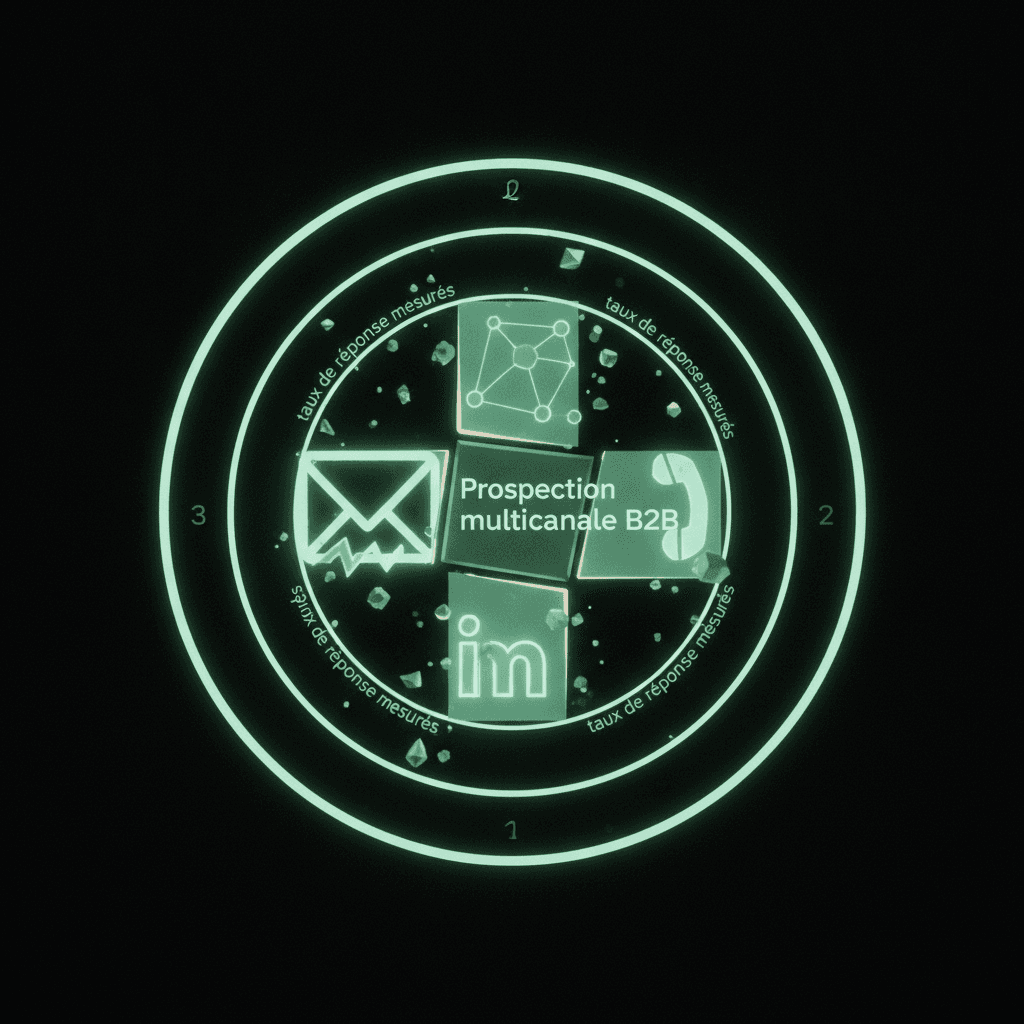
The distinction is important. A well-configured CRM is not an automated CRM. Most teams have Salesforce, HubSpot, or Pipedrive, but use them like a data entry spreadsheet. Automation begins when data enters without human intervention and sales actions are triggered by signal, not by mental reminder. This is the foundation of any sustainable multichannel prospecting approach.
Why automate your CRM in 2026?
Because selling time has become the rarest resource for your teams. According to the Salesforce State of Sales (6th edition, 2025), 68% of salespeople cite note-taking and data entry as their most time-consuming tasks. Every hour spent documenting a call in the CRM is an hour that generates no revenue. In 2026, the question is no longer "should we automate?" but "how much selling time are you still losing manually?".
The calculation is concrete. A team of five salespeople who recover 15% of selling time—the low end of the range cited by McKinsey for automating non-client activities—frees up the equivalent of one full-time salesperson. You haven't hired, you've unlocked existing capacity. This is the reasoning that makes automation a priority over hiring when budgets tighten.
According to McKinsey, the most successful B2B sales organizations have freed up approximately 20% of their salespeople's capacity and improved their productivity by up to 30% through automation ([McKinsey](https://www.mckinsey.com), 2025). This is not an individual productivity gadget: it's a team-wide growth lever, measurable in pipeline created and shortened cycles.
Which sales processes should you automate first?
Start with high-frequency, low-judgment tasks: those that recur daily and require no relational finesse. Automating haphazardly wastes your effort. The rule is simple: target what is repetitive, predictable, and event-triggered. Here are the four areas that yield the quickest returns.
1. CRM data entry and updates
This is the primary source of loss. Connect your email, calendar, and calling tool to the CRM so that activities are logged automatically: emails linked to the correct contact, calls recorded, appointments created as tasks. The goal is for a salesperson to never again have to re-enter what they just did. Data becomes a byproduct of action, not an evening chore.
2. Lead enrichment and routing
An incoming lead must be qualified, enriched, and assigned to the right salesperson in seconds, not the next day. Automatic assignment rules (territory, account size, scoring) and data enrichment via tools like Clearbit, Cognism, or Societeinfo eliminate the first contact delay—often the number one factor in conversion rates.
3. Follow-up sequences
The majority of B2B sales happen after multiple contacts, and most salespeople give up too early. Automated email and task sequences—triggered by a lack of response or a signal of interest—ensure no prospect falls through the cracks. The human takes over at the right moment; the machine manages the cadence. This is where automated cold email truly shines.
4. Reporting and forecasting
Pipeline dashboards, forecasts, and activity reports should build themselves. No more Friday Excel extractions. Automated reporting gives management real-time insights and gives salespeople back the hours they spent documenting their own performance.
How to double sales productivity without hiring?
Doubling productivity doesn't come from a tool, but from a three-step method: measure, clean, automate. Teams leveraging AI and automation show significantly higher revenue growth—83% of them saw their revenue increase over the year, compared to 66% of teams without AI (Salesforce, State of Sales, 2025). But the difference isn't in the technology: it's in the discipline with which it's deployed.
Step 1 — Measure where time goes
Before automating anything, map out a typical week for your salespeople. How many hours are spent on data entry, research, reporting, meetings? You cannot recover time you haven't measured. This snapshot almost always reveals two or three tasks that, alone, consume a third of the week.
Step 2 — Clean data before automating it
Automating on a dirty database amplifies chaos. Duplicates, empty fields, inconsistent statuses: every flaw propagates at machine speed. First, establish a clean data model—mandatory fields, unique nomenclature, deduplication rules—then connect automation to it. This order is non-negotiable.
Step 3 — Automate in waves, measure impact
Deploy one project at a time—CRM data entry first, for example—and measure the time actually recovered before moving on to the next. This wave approach avoids a complex system, allows teams to adopt each change, and gives you quantifiable proof at each step. Productivity doesn't double all at once; it doubles through the accumulation of verified gains.
What tech stack for B2B sales automation in 2026?
The right stack is not the most comprehensive, it's the most integrated. A clean central CRM (Salesforce, HubSpot, Pipedrive), a data enrichment tool, a multichannel sequencing platform, and an automation connector (native, or via Make/Zapier/n8n) are enough to cover 90% of the needs of an SME or a scale-up. The classic mistake is to pile up tools that don't communicate: each integration break recreates manual entry.
A word on generative AI. Sales copilots write emails, summarize calls, and suggest the next action. When used well, they genuinely accelerate work: according to Gartner, salespeople who collaborate effectively with AI are 3.7 times more likely to achieve their quota. But AI amplifies a method; it doesn't replace it. On a poorly structured base, a copilot produces useless suggestions faster. The foundation remains data and process.
Mistakes that sabotage CRM automation
Most automation projects fail not due to a lack of tools, but due to excessive haste. Here are the most common mistakes that turn a promising investment into a complex system abandoned by teams.
- Automating the relationship. High-judgment tasks—negotiation, closing, objection handling—remain human. Automate logistics, not the connection.
- Connecting automation to dirty data. Without a clean data model, you industrialize your errors.
- Deploying everything at once. An automation big bang overwhelms teams and makes debugging impossible. Proceed in waves.
- Forgetting adoption. A workflow that salespeople bypass is useless. Involve them in the design.
- Not measuring. Without quantifiable before/after, you'll never know if automation truly recovered selling time.
FAQ — CRM Automation and B2B Sales Enablement
What is the difference between CRM automation and sales enablement?
CRM automation has the system execute repetitive tasks (data entry, follow-ups, reporting). Sales enablement provides salespeople with content, data, and tools to sell faster. The two complement each other: automation frees up time, enablement makes that time more productive.
Can you really double sales productivity without hiring?
Yes, by recovering lost time. A salesperson sells only about 30% of their time (Salesforce, 2025). Automating non-selling tasks can recover 15 to 20% of selling time according to McKinsey, which is equivalent to an additional full-time position on a team of five—without hiring.
Where to start when automating your CRM?
Start with CRM data entry and updates, the number one source of loss: 68% of salespeople cite data entry as their most time-consuming task (Salesforce, 2025). Connect email, calendar, and calling tools so activities are logged automatically, then extend to enrichment and follow-ups.
What tools for B2B sales automation in 2026?
A clean central CRM (Salesforce, HubSpot, Pipedrive), a data enrichment tool, a multichannel sequencing platform, and an automation connector (Make, Zapier, n8n) cover most needs. The priority is not the number of tools but their integration: each break recreates manual entry.
Does AI replace salespeople in an automated CRM?
No. AI automates logistics and assists decision-making, not relationships. Salespeople who collaborate with AI are 3.7 times more likely to achieve their quota (Gartner, 2024), but closing, negotiation, and trust remain human. AI amplifies a method; it doesn't replace it.
Take Action
CRM automation is not a technical project; it's a productivity decision: giving your salespeople back the selling time that administrative tasks confiscate. The potential is real—15 to 20% of time recovered, an entire capacity freed up on a team of five—but it's captured with method, not with a pile of tools. If you want to know exactly where your team loses time and which processes to automate first, request your free growth audit: we will map your selling time losses and prioritize the automations with the highest impact.
Sources
- Salesforce, State of Sales (6th edition), retrieved 06.07.2026, https://www.salesforce.com/sales/state-of-sales/sales-statistics/
- McKinsey & Company, The future of B2B sales / automation in sales, retrieved 06.07.2026, https://www.mckinsey.com
- Gartner, Seller AI adoption survey, retrieved 06.07.2026, https://www.gartner.com