
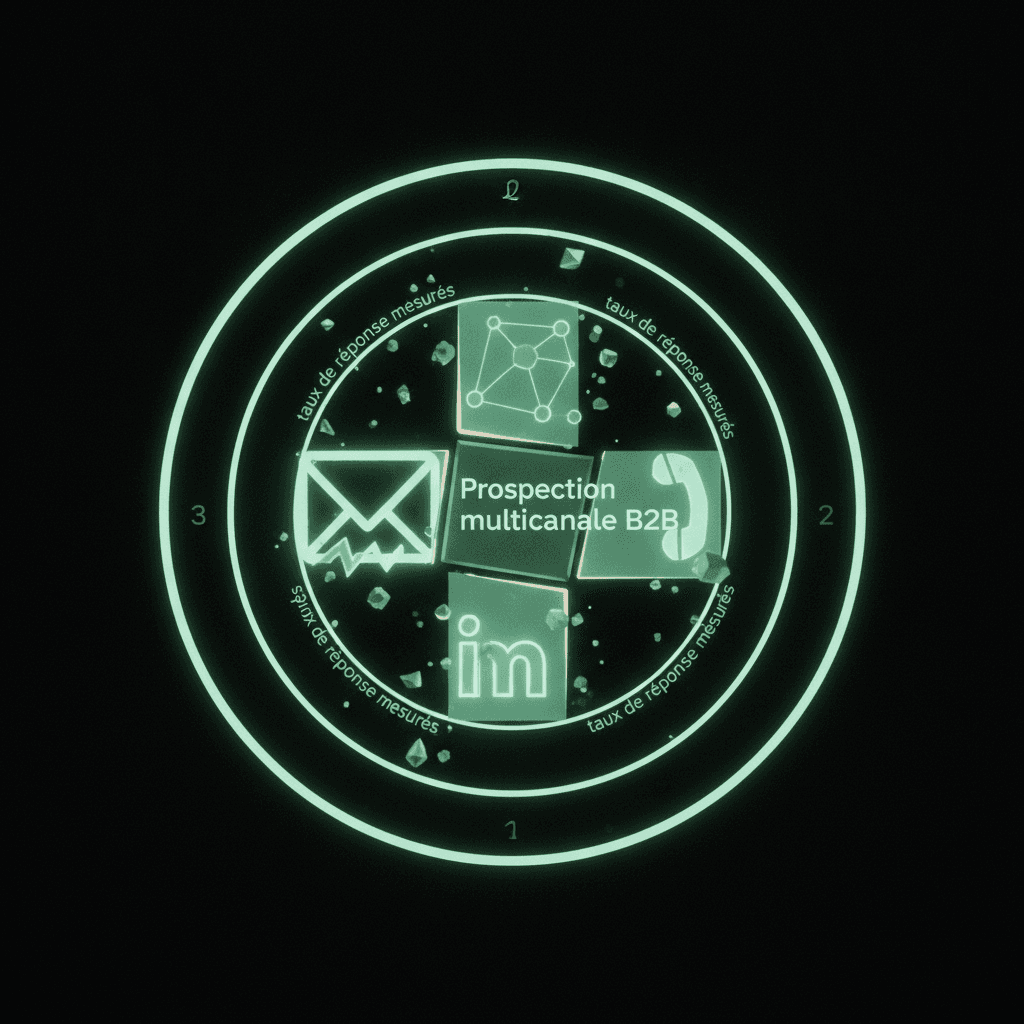
A single email generates a 3.1% response rate. A LinkedIn message alone, 4.8%. A phone call alone, 7.2%. Combining all three, in the right order and timing: 16.3%. These figures come from analyzing 1,247 B2B prospecting sequences conducted at Uclic between 2023 and 2026. Multichannel prospecting isn’t about spamming across every channel — it relies on a precise, tested, and fine-tuned cadence. Here’s exactly what it delivers and how to replicate it.
Why Multichannel Prospecting Outperforms Any Single Channel
The answer boils down to a simple principle: each channel reaches a different subset of the same prospect. Some respond to emails in the morning, others check LinkedIn at 6pm, others ignore unknown calls but always call back. Reaching the same person through three distinct channels multiplies your chances of catching the right attention window — without feeling like harassment if the cadence is consistent.
The Salesloft study (2025, 540,000 sequences analyzed) confirms that a 3+ channel sequence generates 2.4× more meetings than an email-only sequence targeting the same prospect list. The key is channel order and intervals, not sheer volume of outreach.
The Exact Cadence Tested Over 3 Years (and What We Dropped)
We tested dozens of sequence variants. The cadence below delivers the best ratio of meetings booked to perceived annoyance across our panels. It spans 14 business days, 7 touchpoints, 3 channels.
| Business Day | Channel | Action | Goal |
|---|---|---|---|
| D+0 | Email 1 — value proposition + social proof | First contact — plant the seed | |
| D+1 | Profile visit (no message) | Passive signal — prospect sees your name | |
| D+3 | Connection request (short note, max 150 characters) | Establish connection — ~35% acceptance rate | |
| D+5 | Email 2 — light follow-up, different angle | Reminder loop — +2.1 pp response rate | |
| D+7 | DM message if connection accepted (otherwise: skip) | Warm conversational channel | |
| D+10 | Phone | Call — 20-second script + voicemail if no answer | Direct decision — best conversion rate |
| D+14 | Email 3 — closure / sequence end | Last chance + respect for the prospect |
What we dropped along the way: sequences with 10+ touches over 30 days. Unsubscribe rates skyrocketed after D+14, and the marginal meeting gain beyond that point didn’t justify the damaged domain reputation. Seven touches in 14 days is the sweet spot.
Channel 1 — Email: 3 Rules to Land in the Inbox
Deliverability is everything. An undelivered email has a zero response rate. Before optimizing copywriting, here are three non-negotiables:
- Separate prospecting domain — never send from your main domain. Buy an alias (e.g., hello-[firstname]@your-company-group.com) and warm it up for 4 to 6 weeks using a tool like Lemwarm or Mailreach before your first real send.
- SPF + DKIM + DMARC configured and verified — the minimum entry ticket since 2024. Google and Microsoft silently block senders without full authentication. Check via MXToolbox before each new campaign.
- Controlled volume — don’t exceed 30 emails/day/domain for the first 4 weeks, then 50/day after. Our data shows domains starting at 100/day burn their reputation in under 3 weeks.
Regarding message content: a subject under 40 characters, a first sentence proving you’ve researched the prospect (news, LinkedIn post, funding round), and a single CTA (not three). Our highest-performing emails average 82 words — not 300.
Channel 2 — LinkedIn: Messages That Trigger Responses
LinkedIn remains the B2B channel with the highest perceived credibility — a LinkedIn message from a stranger is better received than an unsolicited email because the sender’s profile is visible and verifiable. But this credibility is destroyed by two behaviors:
- Sending a pitch in the connection request note — acceptance rates drop 2.7× compared to a note-free request or a short contextual note (e.g., “I saw your post on [topic], would love to connect”).
- Pitching in the first DM after acceptance — best response rates come from curiosity- or validation-oriented first DMs (“I’m working on [topic], curious if you’ve faced this issue”) rather than direct proposals.
In our panel, LinkedIn DMs asking a simple closed question (“Is [problem X] a priority for you this quarter?”) show a 23% response rate versus 8% for pitch-style DMs.
Channel 3 — Phone: The 20-Second Script That Gets Picked Up
Phone calls are the most dreaded channel by teams — and the most underused in B2B prospecting in 2026. Yet, it delivers the highest qualified meeting conversion rate when used after an email and LinkedIn contact: the prospect is no longer a complete stranger.
The 20-second script that works in our campaigns:
“Hi [firstname], this is [firstname] from [company]. I emailed you last week — I work with [similar profile to prospect] on [concrete result]. Do you have 2 minutes now or should I call back later?”
The two key elements: mentioning the email sent (reduces the cold call feel), and immediately offering an alternative time (shows respect for their schedule). Over 3 years of data, this script generates 34% “yes, I have 2 minutes” versus 12% for openers like “I’m calling to introduce our solution.”
The 4 Mistakes That Sink a Multichannel Cadence
After analyzing underperforming sequences in our panel, four patterns consistently emerge:
- Repeating the same message across all 3 channels — if the email says “I’m offering a demo,” the LinkedIn DM shouldn’t repeat “I’m offering a demo.” Each channel must bring a different angle (social proof, open question, contextual urgency).
- Calling too early in the sequence — a call on D+10 (after 3 touchpoints) converts 2× better than a call on D+2. The prospect has had time to "meet" you on two channels before you pick up the phone.
- Using the same sequence for all profiles — a CEO of a 20-person SMB and a VP Sales at a 200-person scale-up don’t prefer the same channels. VP Sales respond 40% more often on LinkedIn than email; SMB leaders respond the opposite. Segment accordingly.
- Stopping after the first “no” — in our database, 31% of meetings come from prospects who didn’t respond to the first 4 touchpoints. Continuing the sequence to the end (with respectful timing) pays off.
What Multichannel Cadence Can’t Fix
Cadence amplifies what’s already there. It doesn’t compensate for:
- An unfiltered prospect list (vague ICP = response rate divided by 3 even with perfect cadence)
- A vague value proposition (“we help companies with digital transformation” — no one replies to that)
- Volumes that burn email reputation before the sequence ends
The rule we apply before launching any sequence: if we can’t sum up in one sentence what the prospect concretely gains by spending 20 minutes with us, the sequence shouldn’t go out.
FAQ — B2B Multichannel Prospecting
- How many channels should be combined in multichannel prospecting?
- Three channels (email + LinkedIn + phone) represent the optimal balance point. Beyond that, marginal gains are small and the risk of damaging sender reputation increases. Below two channels, the cross-channel repetition effect disappears.
- What is the right interval between touches in multichannel prospecting?
- 2 to 3 business days between each contact minimizes perceived irritation while maintaining memorability. Less than one day feels like harassment. More than 5 days means the prospect forgets you.
- Should each message be personalized in a multichannel sequence?
- Yes, at least the first line — and differently per channel. Email can personalize via company news; LinkedIn message should reference a recent post or activity of the prospect; phone call should mention the sent email to reduce the "pure cold call" effect.
- Which tools to orchestrate multichannel prospecting?
- The most used tools in 2026: La Growth Machine or Lemlist for combined email + LinkedIn sequences, Aircall or Ringover for call tracking, HubSpot or Pipedrive as central CRM. The key is that all three channels are logged in a single tool to measure the full sequence per prospect.
- Is multichannel prospecting GDPR compliant?
- In B2B, email and phone prospecting to professional contacts falls under legitimate interest — it’s lawful provided each email includes an unsubscribe link, deletion requests are honored immediately, and personal addresses are not targeted. LinkedIn is governed by its own terms limiting mass commercial InMails.